


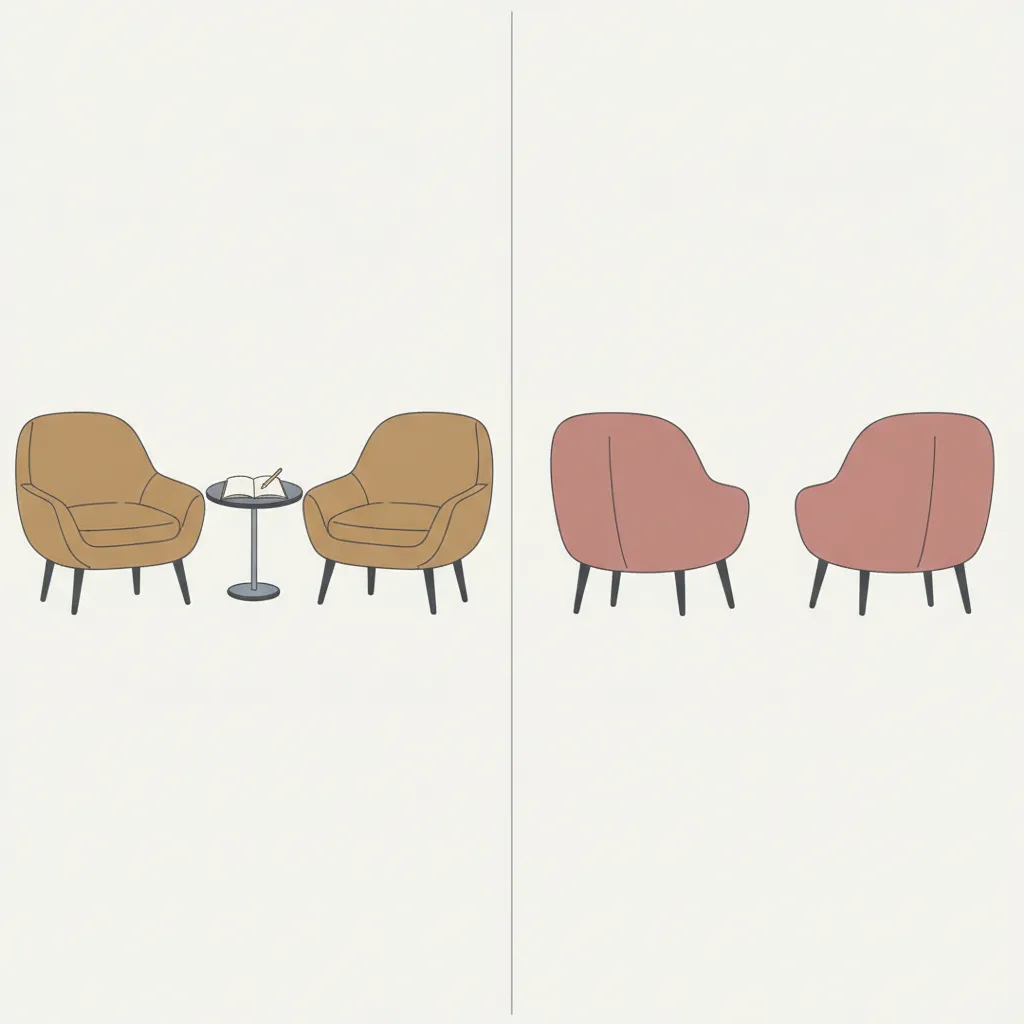




Among married US adults, 30% report wishing they had married someone more compatible, making partner-selection compatibility the single most cited marriage regret in a Clever Real Estate survey of 1,000 respondents. Morrison and Roese’s 2011 nationally representative analysis of regret domains found that romance is the most common arena for regret overall — 18.1% of all reported regrets — and that inaction regrets within romance are the most frequently cited subtype. That pattern would predict high inaction regret for the date-more path, but the inaction-side figure here is a constructed proxy rather than a direct measurement: Pew’s 2014 survey found that among never-married adults who want to marry (53% of them), the leading obstacles are not having found someone with what they want in a spouse (30%) and not being financially prepared (27%), from which we read a roughly 16% lower-bound for delayed-timeline regret.
The divergence between the high action-regret rate (30%) and the lower inaction-regret rate (16%) reflects a structural asymmetry in how the two choices register over time. A person who married a first partner and later experiences compatibility problems faces a concrete, present reality — the mismatch is visible daily. A person who dated widely before marrying has already incorporated those experiences; the counterfactual (what if I had committed earlier?) remains abstract and does not carry the same vividness. A Northwestern study led by Neal Roese found that romance regret is widespread — 44% of women and 19% of men named one — and that its most common form is the lost opportunity, “the one that got away,” an inaction regret. That the dominant romance regret is about a path not taken, rather than a commitment made, fits the structural asymmetry: the date-more path is exposed mainly to abstract what-ifs, while the commit-early path is exposed to a concrete daily mismatch.
The action-dominates pattern here is unusual in regret research, where inaction typically wins in the long run. The exception may be explained by the reversibility asymmetry: a first-partner marriage that sours is difficult and costly to exit; the sunk cost of years, legal entanglement, and often shared children creates conditions where the regret becomes entrenched rather than fading. Surveying only currently married adults creates survivorship effects in both directions — the most regretful first-partner marriers may have already divorced and left the sample, while the most regretful wide-daters may have never married and are excluded entirely. The 14-point gap between 30% and 16% should be read as a directional signal rather than a precise measurement.