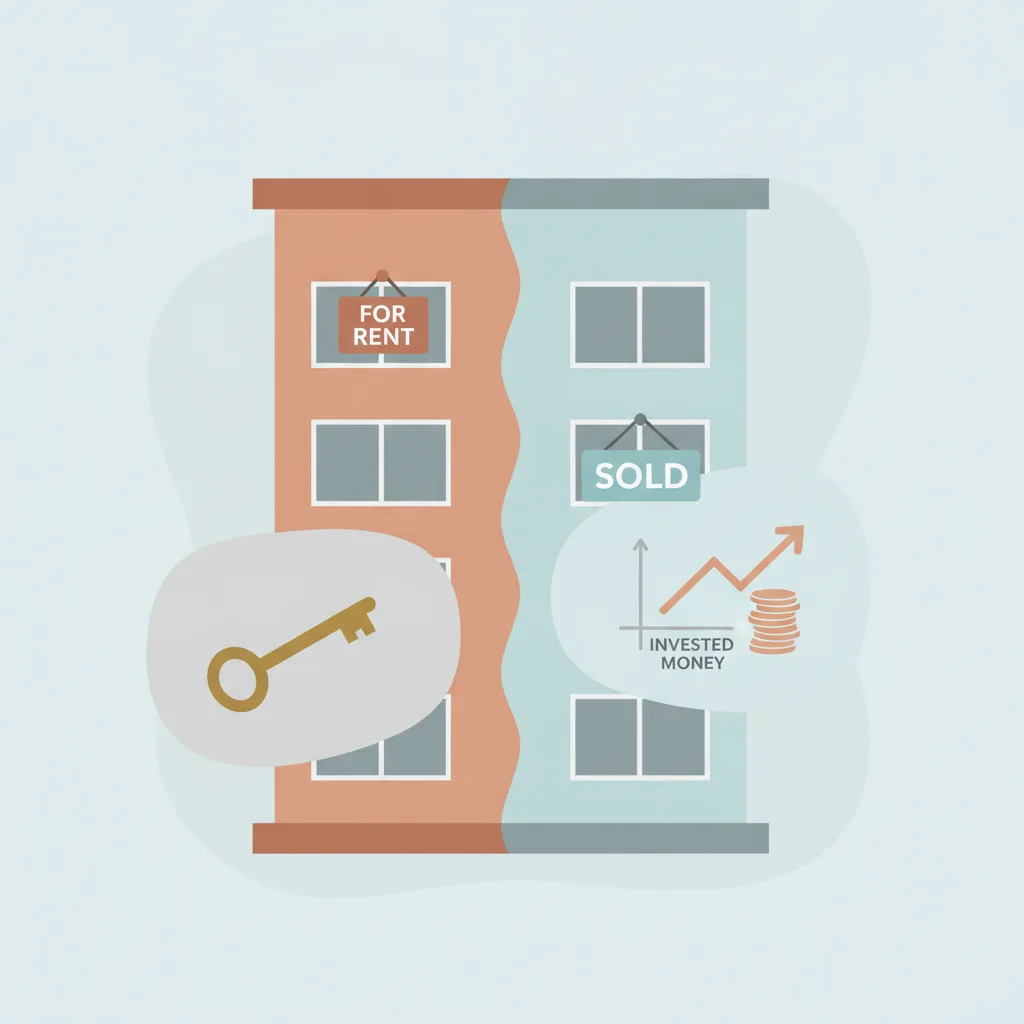
Renting out a property you own vs selling it and investing the money
If you act
Selling and investing the proceeds
25%
If you don't
Keeping it and renting it out
40%
Percentage who later regret each choice. Bars and full ledger render below.
Financial
Last reviewed 2026-07-09
Evidence quality 4.13/5
Eight-dimension review score against the
quality rubric
. Each dimension scored 1–5.
D1 Source verification
4/5
D2 Source authority & independence
4/5
D3 Regret-rate accuracy
3/5
D4 Source comparability
4/5
D5 Gilovich pattern
4/5
D6 Prose quality
5/5
D7 Caveat completeness
4/5
D8 Sample quality
5/5
Average4.13/5
Proxy data — no direct regret survey exists for this decision. Rates are derived from satisfaction scores and access-barrier data rather than questions that directly asked about regret. See caveats below.
Action regret
Selling and investing the proceeds
25%
25% of home sellers regret selling — they miss the home they gave up
US adults who sold a home in 2021–2022 (Clever Real Estate 2022 survey)
retrospective, within ~1–2 years of the sale
Inaction regret
Keeping it and renting it out
40%
40% of rental-property owners wish they'd never started
US residential real estate investors / landlords (Clever Real Estate 2024 survey)
retrospective, current owners
% who regret this choice
Selling and investing the proceedsKeeping it and renting it out
25%40%
inaction dominates — Inaction dominates — most regret not acting.
Related decisions
Semantically similar decisions — same territory, different trade-offs.
No survey pits “rent it out” directly against “sell it and invest the money,” so this pairs the two closest measured regrets. About 40% of residential rental owners wish they’d never started investing in real estate (Clever Real Estate’s 2024 survey of 764 investors), against about 25% of recent sellers who regret selling because they miss the home they gave up (Clever’s 2022 survey of 1,000 sellers). On those proxies, keeping-and-renting is the more-regretted path — the opposite of the intuition that selling is the move you might kick yourself for later.
The reason keep-and-rent regret runs high is that landlording is not the passive income it is sold as. In the same 2024 survey, 56% of owners had already had to evict a tenant, 61% were still chasing missed rent every month, and 87% reported some regret about their investment decisions. The NBER study of landlords’ own lease ledgers puts a price on the hassle: filing a single eviction costs the equivalent of two to three months’ rent, and nonpayment is common enough that many landlords tolerate months of it before acting. Against that, the seller’s regret is quieter and more emotional — missing a home — rather than a recurring operational drain.
Read the gap cautiously. This is a proxy pairing, flagged as such: the two numbers come from different people surveyed in different years, the seller figure includes forced moves that mix circumstance with choice, and the investor sample leans toward heavily-invested owners who may regret more than a one-flat landlord would. It also says nothing about the money — whether renting out or selling-and-investing wins financially depends on rental yield, local price growth, and what the sale proceeds earn elsewhere, none of which a regret rate measures. The Gilovich pattern (holding-and-managing regret accumulates while the sold home fades into a wistful memory) fits the direction here, but the evidence is indicative, not a head-to-head test.
Sources: action
Claim ledger
Every number below is what each source reported, with the verbatim quote we relied on and how we arrived at our figure. Click any link to verify directly.
[1]Clever Real Estate — American Home Seller Report: 2022 Edition
Reference source
One-fourth of home sellers (25%) regretted selling because they miss their old home
Excerpt
“"One-fourth of respondents (25%) regretted selling because they miss their old home" — from a survey of 1,000 people who sold a home in 2021 or 2022 (fielded Sept. 29 – Oct. 2, 2022).
”
Source data from
2022-10-12
Accessed
2026-07-09
Calculation
Used as a proxy for regret about the decision to sell itself. The 25% "miss their old home" figure is the cleanest available decision-construct regret for sellers — distinct from the much larger "process" regret numbers (priced too low, sold too fast, commission too high) that other seller surveys report, which measure regret about how the sale went, not regret about having sold. Because it is a proxy (not a head-to-head "sell vs rent-out" survey), this entry is flagged proxy_only.
Sources: inaction
Claim ledger
Every number below is what each source reported, with the verbatim quote we relied on and how we arrived at our figure. Click any link to verify directly.
[1]Clever Real Estate — Residential Real Estate Investing in 2024: More Rent Money, More Rental Problems↗ 1 other entry
Reference source
40% of residential real estate investors wish they'd never started investing in real estate; 87% have regrets about their investment decisions; 56% have had to evict a tenant
Excerpt
“"40% say they wish they'd never started investing in real estate [...] 87% [...] have regrets about their investment decisions [...] More than half of respondents (56%) have had to evict a tenant at some point." — survey of 764 US residential real estate investors, fielded May 18–June 9, 2024.
”
Source data from
2024-07-01
Accessed
2026-07-09
Calculation
The 40% "wish they'd never started" figure is used as the regret proxy for the keep-and-rent side. The broader 87% "have regrets" figure is not used as the headline because it spans market and financial regrets, not the decision to become a landlord specifically. Sample skews toward active, heavily-invested owners (90% had lost money on an investment).
[2]National Bureau of Economic Research (NBER Working Paper 33155) — Nonpayment and Eviction in the Rental Housing Market↗ 1 other entry
Primary study
Filing an eviction costs landlords the equivalent of 2–3 months of rent; nonpayment is common and frequently tolerated before eviction
Excerpt
“"Filing an eviction costs landlords the equivalent of 2-3 months of rent [...] Nonpayment is common, is frequently tolerated by landlords, and is often followed by recovery."
”
Source data from
2024-11-01
Accessed
2026-07-09
Calculation
Cited to explain why keep-and-rent regret runs high: landlording carries real, recurring costs (an eviction alone runs 2–3 months' rent), which the "passive income" framing understates. Corroboration for the regret driver, not a regret rate itself.
Caveats
This is a proxy_only pairing: no survey asks the same people whether they regret choosing to rent out a property versus selling it and investing the money, so each side uses the closest available construct. The action side (selling) is proxied by the 25% of recent sellers who "miss their old home" (Clever 2022); the inaction side (keeping and renting) is proxied by the 40% of rental owners who "wish they'd never started investing in real estate" (Clever 2024). The two figures come from different samples (sellers vs. investors) in different years (2022 vs. 2024), so the comparison is indicative, not a controlled contrast. The seller "miss my home" figure includes people forced to move by a job change or finances, conflating circumstance with choice; the investor sample skews toward active, heavily- invested owners (90% had lost money on an investment), likely overstating regret for someone renting out a single inherited or vacated flat. Crucially, regret rates say nothing about the money: whether renting out or selling-and- investing produces the better financial outcome depends on rental yield, local price appreciation, and market returns on the sale proceeds — all path- and timing-dependent, and not captured here. Framing is US-based; tenant- protection law and transaction costs differ sharply by country.