Evidence quality 4.38/5
Eight-dimension review score against the quality rubric . Each dimension scored 1–5.
- D1 Source grounding
- 4/5
- D2 Source authority
- 5/5
- D3 Arithmetic
- 4/5
- D4 Uncertainty
- 4/5
- D5 Scope
- 4/5
- D6 Prose
- 5/5
- D7 Perception honesty
- 4/5
- D8 Caveat completeness
- 5/5
● your factors — click this risk ▾ to reveal
- Your factors
≈ As likely as
Perceived
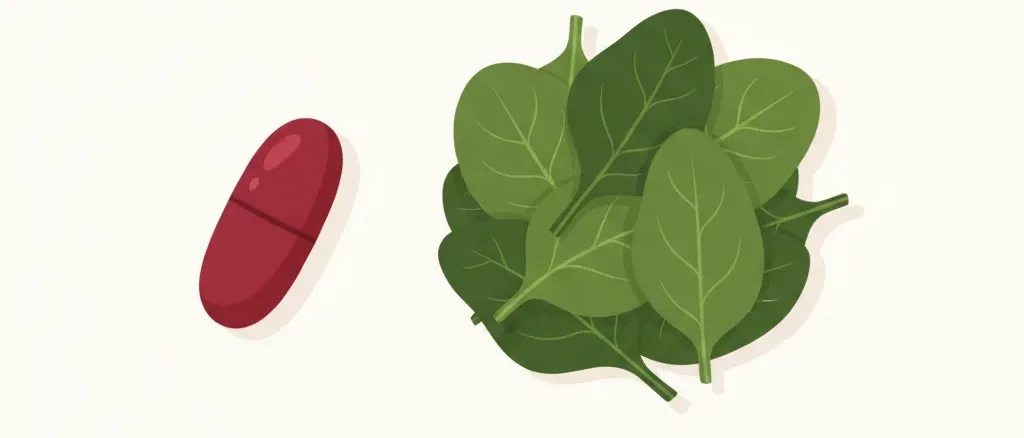
The belief that vegetarian diets inevitably lead to dangerous nutritional shortfalls persists as one of the more durable dietary myths. "Where do you get your protein?" remains the default question directed at anyone who skips meat. The underlying assumption -- that eliminating animal flesh creates a near-certain path to clinical deficiency -- is amplified by anecdotal horror stories of vegans collapsing from B12 depletion and by supplement-industry marketing that treats plant-based eating as a condition requiring pharmaceutical intervention.
Rough estimate: ~30-50% chance of developing a serious nutrient deficiency
Source: editorial intuition, not polled
Actual
~7% B12 deficiency prevalence among lacto-ovo vegetarians (EPIC-Oxford)
British male vegetarians in the EPIC-Oxford cohort
Show derivation
The EPIC-Oxford cohort found B12 deficiency (serum <118 pmol/L) in 7% of vegetarians vs 52% of vegans and <1% of omnivores (Gilsing et al. 2010). This 7% is a cross-sectional biochemical marker threshold, not a clinical diagnosis, and none of this entry's cited sources quantify what share of biochemically deficient vegetarians progress to clinically serious illness (megaloblastic anemia, neurological damage) versus remaining subclinical. Lacking a sourced conversion factor, this entry uses the EPIC-Oxford 7% prevalence directly as the estimate rather than deriving a smaller "clinically serious" figure from unverified assumptions. The Pawlak et al. (2018) review found iron deficiency anemia rates of 6-30.3% among female vegetarians (1.7-29% ferritin deficiency in males), with risk concentrated in premenopausal women; most cases are mild and responsive to dietary adjustment. In the Adventist Health Study-2 cohort, B12 supplements and fortified milk substitutes were the significant contributors of plasma B12 among vegetarians (Rizzo et al. 2018), indicating that supplementing vegetarians can maintain B12 status -- though that study measures within-group association, not the population-wide share of vegetarians who actually supplement.
Caveats: "Vegetarian" spans a spectrum from lacto-ovo diets with daily dairy to near-vega…
"Vegetarian" spans a spectrum from lacto-ovo diets with daily dairy to near-vegan regimens, and deficiency risk varies enormously across that range. The 7% estimate is EPIC-Oxford's raw biochemical B12 deficiency marker rate among vegetarians, used directly because no cited source quantifies what share of that group goes on to develop clinically serious illness -- actual serious-illness incidence for a well-planned lacto-ovo vegetarian diet with access to supplementation is plausibly lower than this figure. Strict veganism without supplementation is a categorically different risk profile. Iron deficiency is more nuanced than B12: lower ferritin stores are common in vegetarians but rarely progress to clinical anemia on a well-planned diet. The Adventist Health Study population may not generalize to all vegetarians, as Adventists have above-average health literacy and supplement use.
Related risks
Other risks on similar themes — for exploring related fears.




Red meat & CRC
How much does eating red or processed meat every day actually raise your colorectal cancer risk?


Charred meat & cancer
How much does eating charred or well-done grilled meat actually raise your cancer risk?

Infant sugar/salt and adult disease
How much does added sugar and salt in the first two years of life raise a child's risk of developing type 2 diabetes and hypertension in adulthood?
Pick challenger
The EPIC-Oxford cohort found biochemical B12 deficiency in 7% of vegetarians — a real but modest number, especially compared to 52% of vegans and less than 1% of omnivores. For iron, Pawlak et al. reported deficiency rates of 12-79% depending on population and diet quality, but actual clinical anemia (as opposed to low ferritin on a blood test) affected 6-30% of female vegetarians and far fewer males. No cited source quantifies what share of that 7% biochemical marker progresses to clinically serious illness, so the lifetime estimate for a well-planned lacto-ovo vegetarian diet uses the 7% EPIC-Oxford figure directly — meaningfully higher than the 4.8% lifetime colorectal cancer risk from eating processed meat daily, and roughly on par with the 7% lifetime risk of appendicitis for a US adult.
The perception gap is driven by conflating subclinical markers with clinical disease. Low serum B12 on a lab panel is not the same as megaloblastic anemia or neurological damage; low ferritin is not the same as symptomatic iron-deficiency anemia. In the Adventist Health Study-2, B12 supplements and fortified milk substitutes were the significant contributors of plasma B12 among vegetarians — supplementing vegetarians maintain their B12 status. The “you need meat to survive” framing ignores that the most common nutritional deficiency requiring supplementation — vitamin D — affects omnivores at similar or higher rates.
The risk profile splits sharply by diet type and planning. A lacto-ovo vegetarian eating eggs, dairy, and a varied diet faces minimal clinical risk. A strict vegan avoiding all supplements is in genuinely different territory: without exogenous B12, clinical deficiency becomes near-certain over years, since no plant food reliably provides it. Premenopausal women on any plant-based diet face elevated iron-deficiency risk due to menstrual losses combined with lower non-heme iron bioavailability — a subgroup where intentional dietary planning or supplementation is not optional.
Related tidbits
A well-planned vegetarian diet carries roughly a ~4% lifetime probability of clinically serious nutrient deficiency. The "where do you get your protein" intuition pegs it nearer ~30-50%. Most shortfalls stay subclinical.
Claim ledger
Every number below is what each source reported, with the verbatim quote we relied on and how we arrived at our figure. Click any link to verify directly.
-
[1] European Journal of Clinical Nutrition (Gilsing et al.) — Serum concentrations of vitamin B12 and folate in British male omnivores, vegetarians and vegans: results from a cross-sectional analysis of the EPIC-Oxford cohort study
Serum concentrations of vitamin B12 and folate in British male omnivores, vegetarians and vegans: results from a cross-sectional analysis of the EPIC-Oxford cohort study- Statistic
B12 deficiency (<118 pmol/L): 52% of vegans, 7% of vegetarians, <1% of omnivores- Excerpt
“"Mean serum vitamin B12 was highest among omnivores (281 pmol/l), intermediate among vegetarians (182 pmol/l) and lowest among vegans (122 pmol/l). In all, 52% of vegans, 7% of vegetarians and one omnivore were classified as vitamin B12 deficient (defined as serum vitamin B12 <118 pmol/l)." ”
- Source data from
- 2010-07-21
- Accessed
- 2026-04-18 · archived copy
- Calculation
- EPIC-Oxford cross-sectional analysis of 689 men. B12 deficiency defined as serum <118 pmol/L. The 7% vegetarian deficiency rate is the native statistic. Note this is a subclinical biochemical marker, not clinical disease -- most of the 7% were asymptomatic. The gap between vegetarian (7%) and vegan (52%) underscores that lacto-ovo vegetarians obtain meaningful B12 from dairy and eggs.
-
[2] American Journal of Lifestyle Medicine (Pawlak et al.) — Iron Status of Vegetarian Adults: A Review of Literature
Iron Status of Vegetarian Adults: A Review of Literature- Statistic
Iron deficiency (low ferritin) in 12-79% of female vegetarians; anemia (low hemoglobin) in 6-30%- Excerpt
“"Among female vegetarians, ferritin deficiency ranged from 12% to 79%, with inadequate hemoglobin concentration ranging from 6% to 30.3%. For males, ferritin deficiency ranged from 1.7% to 29%." ”
- Source data from
- 2018-01-09
- Accessed
- 2026-04-18 · archived copy
- Calculation
- Pawlak et al. literature review of iron status across vegetarian populations. The wide ranges reflect different populations and study designs. The higher end (79% ferritin deficiency) represents poorly planned diets in developing countries; the lower end (12%) represents well-planned diets in Western countries. Ferritin deficiency (low iron stores) is far more common than clinical anemia (low hemoglobin causing symptoms), which is the relevant outcome for "serious deficiency."
-
[3] Nutrients (Rizzo et al.) — Foods and Supplements Associated with Vitamin B12 Biomarkers among Vegetarian and Non-Vegetarian Participants of the Adventist Health Study-2 (AHS-2) Calibration Study
Foods and Supplements Associated with Vitamin B12 Biomarkers among Vegetarian and Non-Vegetarian Participants of the Adventist Health Study-2 (AHS-2) Calibration Study- Statistic
Among Adventist vegetarians, B12 supplements and milk substitutes were the significant contributors of plasma B12, with supplements positively associated especially among vegans and lacto-ovo vegetarians- Excerpt
“"B12 supplements had a significantly positive association with plasma B12 among all subjects (p trend < 0.001), especially among vegans and lacto-ovo vegetarians (p trend < 0.001)... Supplements containing B12 followed by B12 intake from milk substitutes were significant contributors of plasma vitamin B12 concentration." ”
- Source data from
- 2018-06-01
- Accessed
- 2026-04-18 · archived copy
- Calculation
- The Adventist Health Study-2 calibration study is a within-group association study (PMC6024521 / PMID 29867046), not a vegetarian-vs-omnivore difference test. It found that B12 supplements and B12 from milk substitutes were the significant contributors of plasma B12 among vegetarians, with supplements strongly associated especially among vegans and lacto-ovo vegetarians. This supports the estimate that "well-planned" vegetarian diets -- those whose adherents use B12 supplements or fortified milk substitutes -- can maintain plasma B12, carrying much lower deficiency risk than the raw EPIC-Oxford biochemical prevalence (which includes unsupplemented vegetarians) suggests. Note: the study does not directly report that supplementation eliminates a vegetarian-vs-omnivore B12 gap; that cross-group equivalence is not measured here.